
AI and the Complex Problem-Solving
Article 1 in the series: When the Tool Starts Thinking Back

Some problems are simple. The tap is leaking. The form is missing a signature. The meeting needs an agenda.
Some problems are complicated. They require expertise, analysis, and careful sequencing. Designing a bridge, interpreting a financial statement, drafting a legal agreement, or diagnosing a mechanical fault may require trained people using tested methods.
But then there are complex problems.
These are the problems where the moving pieces do not sit still. There are many actors, multiple interests, shifting incentives, incomplete information, power relationships, emotional histories, resource constraints, and more than one possible pathway forward. Even when we act with good intentions, the situation changes as we intervene.
Poverty is complex. Housing is complex. Rural healthcare is complex. Immigration and settlement are complex. Climate adaptation is complex. Community development is complex. Even a small-town arts centre, food bank, farming cooperative, or refugee sponsorship effort can become complex very quickly.
Dave Snowden’s Cynefin framework has been useful to many practitioners because it reminds us that not all problems belong in the same category. In the complex zone, cause and effect are not always obvious in advance. We often understand what worked only after trying something. The work is less about finding one correct answer and more about probing, sensing, responding, learning, and adjusting.
That is where AI begins to matter in a new way.
AI does not remove complexity. It does not make judgment unnecessary. It does not magically turn social problems into technical puzzles. But when used consciously and rigorously, AI can change how individuals and groups enter complex problem-solving.
It gives us a thinking companion.
Complex problems have always needed more than one mind
For much of human history, complex problem-solving required bringing together many people with different forms of expertise. That remains important. But it was often slow, expensive, and uneven.
A planner knew one part of the system. A finance person knew another. A community worker knew the lived reality. A lawyer knew the risk. A politician knew the public mood. A funder knew what could be paid for. A local elder knew what had failed before. A younger person knew what no longer makes sense.
The challenge was not only that knowledge was scattered. The challenge was that human process itself is messy.
In any room where a complex problem is being discussed, personalities matter. Hierarchies matter. Confidence matters. Who speaks first matters. Who has status matters. Who controls the spreadsheet matters. Who is tired matters. Who is afraid to look foolish matters.
Some people dominate. Some withdraw. Some protect turf. Some confuse experience with wisdom. Some confuse newness with insight.
This does not mean human judgment is poor. It means human judgment is social.
And because it is social, it is often shaped by more than the quality of the argument.
AI offers a different kind of support. It can help map the moving pieces. It can ask what assumptions are being made. It can generate possible pathways. It can compare risks. It can identify constraints. It can suggest who is affected and who has not been heard. It can help imagine best-case, worst-case, and most-likely scenarios. It can translate a vague concern into a clearer decision point.
This is not because AI is wiser than humans. It is because AI can hold, rearrange, and test many strands of thinking at once.
A person facing a complex problem can now ask:
What are the possible pathways here?
What would make each pathway fail?
Who benefits and who carries the burden?
What has been tried elsewhere?
Which lessons travel well, and which ones do not?
What local variables would change the answer?
What might we try first as a low-risk probe?
What are we not seeing because we are too close to the problem?
Until recently, many of these questions required a facilitator, consultant, analyst, strategist, or expert group. They still may. But AI lowers the threshold for entering that kind of disciplined thinking. It allows a small organization, a board member, a municipal councillor, a farmer, a fisher, a social entrepreneur, or a community volunteer to explore a problem more rigorously before the formal meeting even begins.
That is a quiet but profound shift.
AI can help people move from “this is too big” to “here are five ways to begin.” It can help convert anxiety into inquiry. It can make visible the difference between a constraint, a risk, an assumption, and a decision.
It can help ordinary people rehearse complexity before they are overwhelmed by it.
Learning from elsewhere without copy-pasting elsewhere
AI can also help us learn from other places without simply copying other places.
This may be one of its most powerful uses.
Complex problems are rarely solved by importing ready-made solutions. Copy-paste development has failed often enough. A housing model that worked in Vienna may not work in rural Nova Scotia. A cooperative structure from Kenya may not fit a fishing community in Atlantic Canada. A health navigation model from one province may collapse in another because the institutional relationships, funding rules, geography, culture, staffing, or trust conditions are different.
Context is not decoration. Context is part of the solution.
But learning from elsewhere still matters. We should want to know what other communities, countries, organizations, and sectors have tried. We should want to know what worked, what failed, what quietly collapsed, what scaled, and what only worked because of hidden subsidies, charismatic leadership, unusual trust, or very specific institutions.
The hard part is not finding examples. The hard part is interpreting them.
AI can help with that work. It can compare models. It can ask what conditions made a solution possible in one setting. It can distinguish between the visible program and the hidden enabling factors behind it. It can bring global knowledge into conversation with local realities.
Used well, it does not give us a copied solution. It helps us develop a more marinated pathway.
That word matters to me: marinated.
A good pathway is not simply transferred. It is absorbed, tested, seasoned, challenged, adapted, and made suitable to the place where it must actually live. AI can help with that kind of work. At its best, it can feel like having access to a hundred experts, each looking at the same problem from a different angle: governance, finance, technology, community engagement, risk, international experience, implementation failure, behavioural incentives, policy constraints.
AI can bring some of that breadth into the room.
Not perfectly. Not with real lived accountability. Not with the full wisdom of human experience.
But enough to help us ask better questions and avoid the first lazy answer.
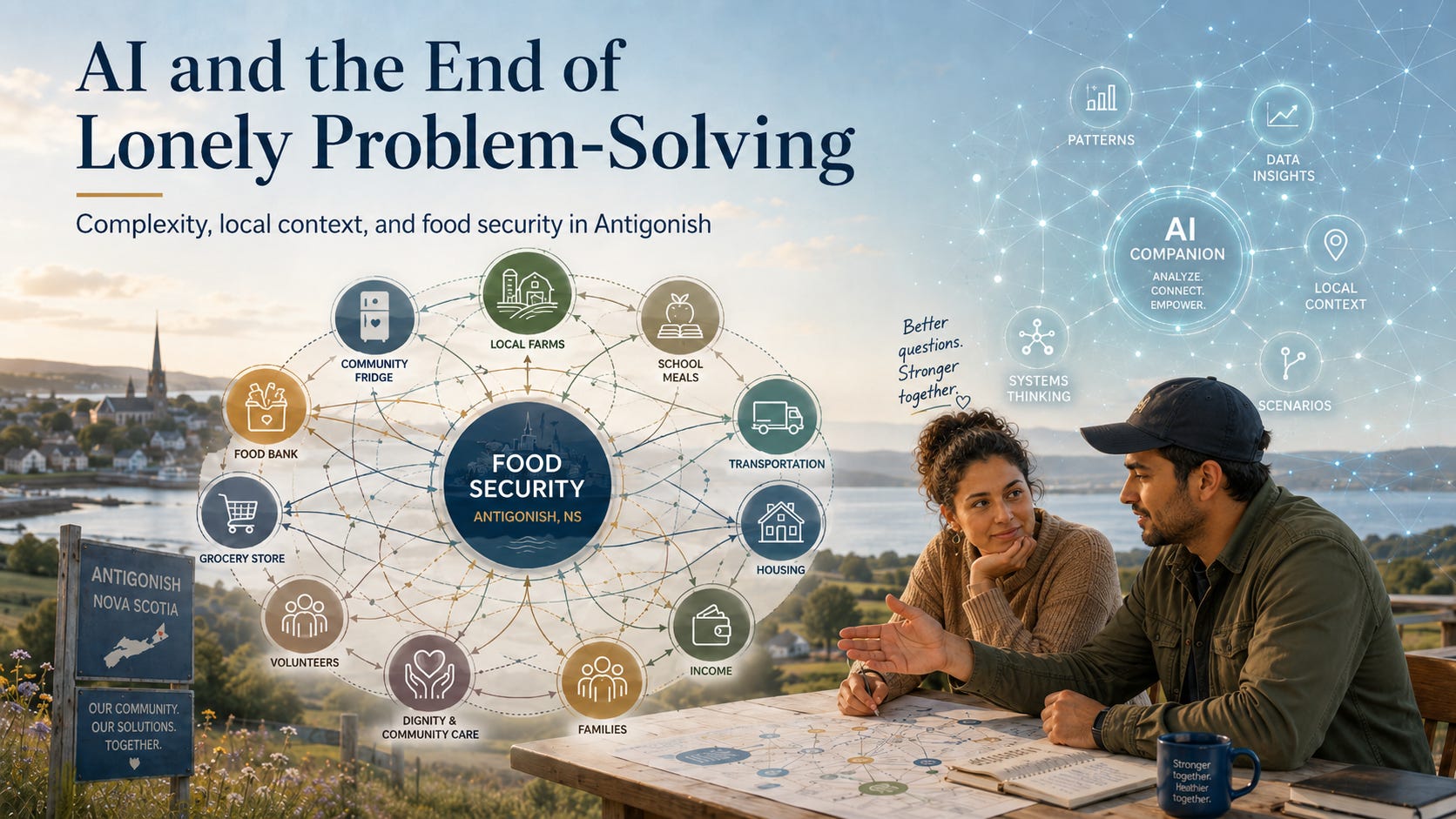
What this could mean for food security in Antigonish
Take food security in Antigonish.
At first glance, the problem may appear simple: some people need food, so we provide food. But the moment we look closer, it becomes complex.
Food insecurity is connected to income, housing costs, transportation, disability, age, family composition, employment, social isolation, food prices, cultural preferences, cooking facilities, stigma, volunteer capacity, school meals, food donations, local farms, grocery stores, prepared meals, community fridges, and public policy.
Behind each of these words is a person making daily calculations: rent or groceries, medicine or transportation, pride or asking for help.
A food bank matters. Community fridges matter. School food matters. Local farms matter. Grocery pricing matters. Transportation matters. Housing matters. Income support matters.
None of these alone is “the solution.”
This is exactly the kind of challenge where AI could help a community think more clearly.
It could help map the local food-security ecosystem. It could compare Antigonish with other rural communities. It could examine where food banks, subsidized CSAs, school meals, community kitchens, grocery vouchers, meal programs, food rescue, and income-based interventions have worked or struggled elsewhere. It could help ask which models fit Antigonish and which do not.
But AI would still need local people to keep correcting it.
It would need someone to say: that sounds good, but there is no bus route there.
Or: that assumes people have kitchens. Some do not.
Or: that model depends on paid staff, and we rely mostly on volunteers.
Or: that food is healthy, but not culturally familiar.
Or: that approach looks efficient, but people may feel ashamed using it.
Or: that partnership exists on paper, but the relationship is not yet strong.
Or: that idea works in a city, but our geography is different.
This is the real promise: not AI replacing community knowledge, but AI helping community knowledge become more structured, comparative, and strategic.
It can help a community ask better questions:
Where is the actual bottleneck — food supply, income, transport, storage, dignity, nutrition, coordination, or awareness?
What would help immediately, and what would reduce need over time?
Which interventions are low-cost but high-impact?
Which ones require deep coordination?
Where are we duplicating effort?
Where are people falling through the cracks?
What can we learn from elsewhere, and what must be adapted here?
That is not a small thing.
For communities trying to solve hard problems with limited time, limited money, and stretched volunteers, better and more cohesive, informed, local-reality-weighed thinking is itself a resource.
The human must remain in charge!
This is the trick.
AI should be used as a companion for analysis, not as a replacement for human judgment.
It may have enormous data access and analytical power. It may help us compare models, surface risks, and generate pathways. But it still relies on human beings to provide reality, context, values, lived knowledge, institutional memory, and moral judgment.
If those are not provided well, AI will fill the gaps.
And when AI fills the gaps, it may make assumptions that sound rational but lead to poor outcomes. It may assume a level of funding that does not exist. It may assume trust between institutions that is not there. It may assume people will behave as policy models suggest, rather than as tired, busy, wounded, hopeful, proud, fearful, or practical human beings actually behave.
This is why humans must keep fine-tuning the analysis.
They must say: no, that will not work here.
They must say: you have missed the politics.
They must say: the formal structure exists, but the real relationship is broken.
They must say: the data says one thing, but lived experience says another.
They must say: this option is technically elegant but socially impossible.
They must say: this pathway looks slower, but it may build trust.
In other words, AI can stretch the thinking process, but humans must ground it.
The real promise is not AI instead of human process. The real promise is AI improving human process.
That distinction matters.
If AI replaces human judgment, we may get faster mistakes. If AI supports human judgment, we may get better questions, richer options, more honest trade-offs, and more careful pathways.
AI should not be treated as the driver of complex social change, even if there will be a temptation to see it that way. That temptation itself carries risk.
It should be the additional thinking companion sitting beside the people who must live with the consequences of the decision.
From individual advantage to collective intelligence
At the moment, much AI use is still individual. One person uses it to become faster, sharper, more prepared, or more impressive. In some settings, it can even become another quiet competition: who can appear more knowledgeable, who can produce the better document, who can arrive at the meeting with the most polished analysis.
That is useful, but limited.
If AI remains only an individual productivity tool, it may simply amplify existing inequalities inside organizations and communities. The person already comfortable with language, strategy, technology, and confidence may become even more powerful. The quieter voices may still remain quiet. The collective intelligence of the group may not improve.
The bigger possibility is different.
AI could become a collective thinking companion.
Imagine a board, council, cooperative, community group, or public agency using AI not to replace discussion, but to improve it. Before making a decision, the group could ask AI to map the issue from multiple perspectives. During the process, it could help distinguish facts from assumptions, risks from fears, and options from preferences. After the discussion, it could summarize tensions honestly without forcing false agreement. It could preserve minority concerns. It could help design safe-to-fail experiments rather than pushing premature consensus.
This would require discipline. It would require transparency. It would require people to stop using AI as a private advantage and start using it as shared infrastructure for better thinking.
That cultural shift has not fully happened yet.
Businesses may move faster because the motivation is obvious: reduce cost, improve productivity, find markets, manage risk, increase profit.
The social sector, governments, community organizations, and political systems may move more slowly. Their work is often more relational, more accountable, more public, more value-laden, and more constrained. Change is slow. Budgets are tight. Stakes are human. Trust matters. Transformation is often promised, but incrementalism is safer.
Yet these are precisely the places where better complex problem-solving is most needed.
If AI can help a business optimize supply chains, why can it not help a town think through housing?
If AI can help an investor compare market risk, why can it not help a food bank examine demand, dignity, nutrition, supply, volunteer capacity, and client experience together?
If AI can help a corporation scan emerging opportunities, why can it not help a rural region think about immigration, schools, healthcare, transportation, employment, and belonging as one connected system?
The point is not that AI will solve these problems.
The point is that AI may change who gets to think seriously about them.
For a long time, structured thinking has been concentrated in institutions with money, staff, experts, time, and status. AI may begin to loosen that concentration. It gives more people the ability to explore complexity, test pathways, ask better questions, compare global experience, adapt lessons to local reality, and see more of the system.
But this will not happen automatically.
AI used lazily will produce lazy thinking faster.
AI used performatively will produce more polished noise.
AI used privately may strengthen individual advantage.
AI used without humility may confirm bias and create false confidence.
AI used without human grounding may produce rational-sounding but unrealistic pathways.
But AI used consciously, collectively, and rigorously may help us become better at navigating complexity.
That is the promise worth taking seriously.
Not because the machine has the answer.
But because it may help us ask the next question with more courage, more structure, and more imagination — before we pretend we already know the answer.