
Beyond Linear Imagination: When Change Becomes Exponential
Article 3 in the series: When the Tool Starts Thinking Back

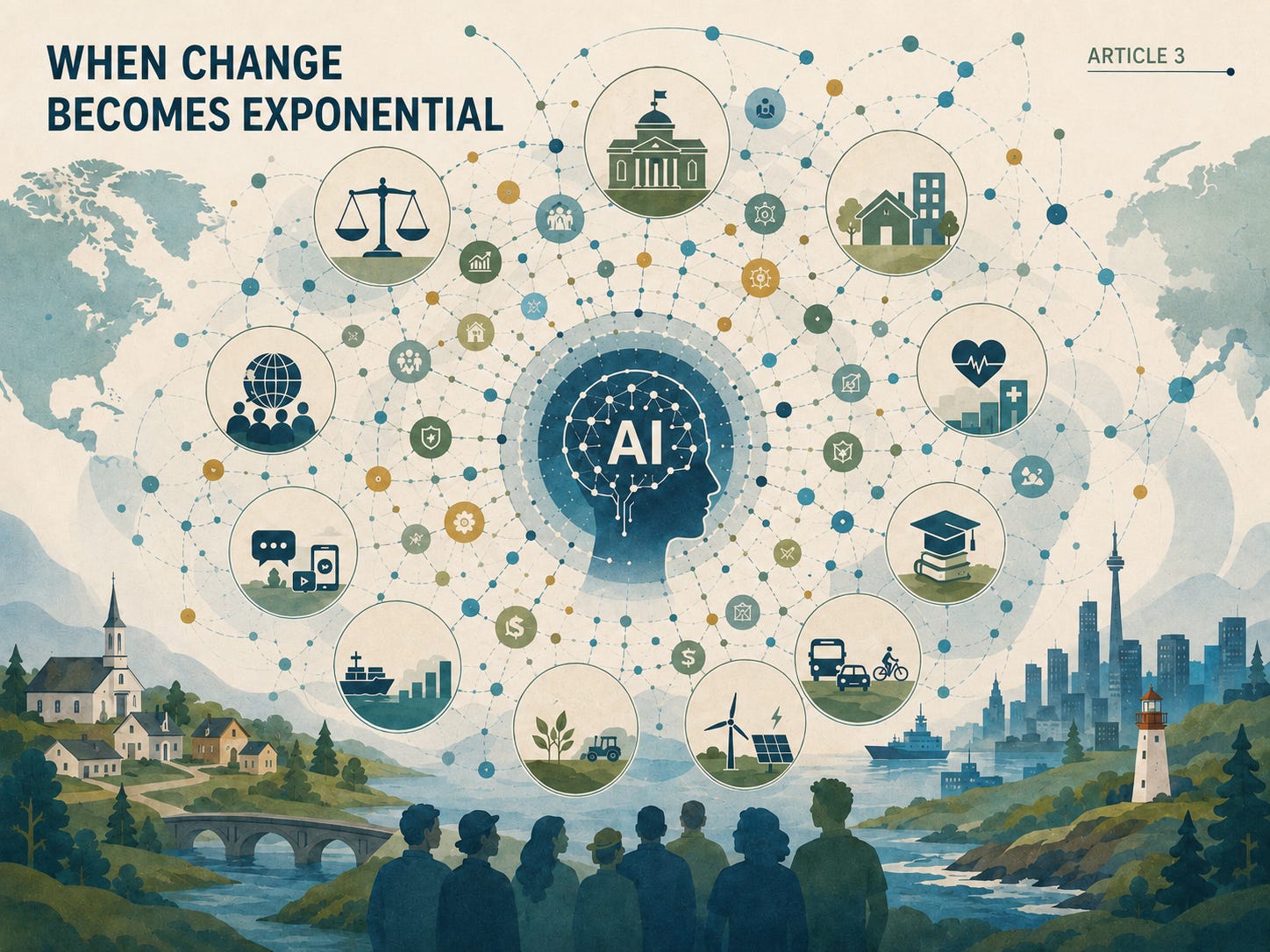
We are making an unintentional mistake.
We keep talking about artificial intelligence as if it is mainly a tool: a faster assistant, a better search engine, a productivity machine, a job threat, a cheating device for students, or a clever way to write emails no one really wanted to receive in the first place.
All of that may be true. But it may also be much too small.
In the first article in this series, I explored AI as a companion for complex problem-solving — a way to hold many moving parts, constraints, pathways, risks, and possibilities in view. In the second, I explored AI and lateral thinking — its ability to help us see across systems, connect what looks separate, and ask what must travel with a clever idea before it becomes tomorrow’s problem.
This third article asks a larger question: what happens when those two capacities begin to spread everywhere? What happens when more communities, institutions, governments, corporations, schools, courts, hospitals, markets, and public agencies can analyze complexity and think laterally at the same time? And what happens when those capacities do not remain stuck in reports, meetings, expert panels, and strategic plans, but begin shaping decisions, services, budgets, laws, markets, classrooms, media, and public imagination?
That is when change stops moving politely in a straight line. That is when it becomes exponential.
Complexity plus lateral thinking, multiplied across millions of settings, becomes a different kind of social force. Not one change. Not one app. Not one sector. Not one productivity gain. Not one job loss. Not one moral panic. Millions of bubbles rising at once — some liberating, some dangerous, some trivial, some profound, some already captured before most of us even notice them.
Tools become worlds
Human beings rarely understand transformative shifts at the beginning. We see the immediate use. We miss the world that follows.
When human beings moved from hunting and gathering to agriculture, perhaps they saw more reliable food, settled life, stored grain, domesticated animals, and a way to survive in one place. But did they see villages, cities, land ownership, taxation, armies, class divisions, writing systems, states, empires, famine, ecological change, and the long human argument over who controls land and food?
Transformative shifts begin as solutions. They become worlds.
The wheel began as a way to move things, but became systems of mobility. Writing began as memory, but became law, scripture, contracts, bureaucracy, constitutions, propaganda, and the struggle over who gets to write history. Printing began as faster copying, but became mass literacy, religious upheaval, newspapers, science, political movements, public education, and misinformation. Steam began as stronger machines, but became factories, railways, industrial cities, empire, pollution, labour movements, and global trade. Medicine began as healing, but became longer life, aging societies, expensive healthcare, pharmaceutical power, pension systems, and new ethical dilemmas. Computers began as calculation, but became smartphones, online banking, social media, surveillance, cybercrime, video calls with grandchildren, and economies running through invisible code.
This is the pattern. A transformative shift rarely remains a tool. It compounds.
AI may be another such shift. But this time, the tool does not only touch food, movement, writing, power, medicine, or calculation. It touches something human beings have often used to define their own uniqueness: thinking.
AI enters language, reasoning, learning, comparison, translation, design, argument, imagination, and decision-making. It enters the space where human beings make meaning, build institutions, justify power, challenge authority, create culture, and imagine futures. That is why its impact may not move in a straight line. It may unfold faster, wider, and in stranger shapes than we are prepared to imagine.
The struggle is over interpretation
AI is not the answer to hunger, injustice, loneliness, climate change, poor housing, weak healthcare, failing education, or democratic decline.
That would be too easy. Also, frankly, too Silicon Valley.
AI is not the answer to society’s hardest questions. But it may change who gets to ask those questions, who gets to understand them, who gets to test possible answers, and who gets to participate in redesigning what comes next.
That is a different kind of power.
The computer revolution gave many people access to information. The internet expanded that access even more. But information did not automatically create a fairer world. Information can overwhelm, confuse, or sit behind jargon, expertise, institutional habits, and power. Anyone who has tried to understand a government form, an insurance policy, a hospital discharge note, a lease, a tax rule, or the fine print of a contract knows that “the information is available” can sometimes mean, “Good luck, dear citizen.”
Generative AI changes something here. It does not only retrieve information. It can help interpret it. It can summarize, compare, translate, explain, question, draft, model, challenge, simplify, simulate, and reframe. It can help institutions and communities move from “we have the data” to “we understand what this data is revealing, hiding, distorting, or demanding of us.”
That shift matters because power often hides behind complexity. A trade agreement is complex. A municipal budget is complex. A hospital system is complex. A provincial housing strategy is complex. Immigration rules are complex. Insurance pricing is complex. Supply chains are complex. School achievement gaps are complex. Justice systems are complex.
Sometimes complexity is real. Life is complicated. Anyone who has tried to assemble furniture with missing screws knows this. But sometimes complexity is protection. It protects professional authority, institutional habits, profit, and people who benefit when others cannot see clearly.
The struggle over AI is therefore not only about jobs. It is about interpretation.
Who gets to understand the rules? Who gets to question the system? Who gets to see the pattern? Who gets to translate jargon into power? Who gets to simulate the consequences? Who gets to decide what counts as knowledge, risk, efficiency, fairness, fraud, productivity, or care?
These are not technical questions. They are democratic questions.
And this is no longer only about personal paperwork. It is also about public life, law, policy, money, and power.
It is now possible for a citizen, a small-town councillor, a nonprofit board, a local journalist, or a community group to begin making sense of issues that once belonged almost entirely to specialists. A trade agreement like CUSMA no longer has to remain a fog of acronyms, legal clauses, sectoral interests, and diplomatic mumbo jumbo while three countries argue over renewal, concessions, and national advantage. AI can help people ask: Who benefits? Which sectors are protected? Which communities are exposed? What is being framed as national interest, and whose interest is quietly missing?
The same applies to a “Build Canada” strategy, a provincial budget, a housing plan, a defence-spending commitment, a climate-transition package, or a municipal capital plan. AI can help citizens and institutions read beyond the headline. What is being proposed? What is being hidden? What assumptions are weak? Which social challenges are being favoured, neglected, or postponed? Who receives investment? Who receives language? Who receives silence?
It is also becoming possible to examine public policies, constitutions, court decisions, regulations, tax rules, and institutional mandates with far more confidence than before. Not perfectly. Not without risk. Not without the need for lawyers, accountants, policy experts, historians, or people who know the local reality. But the first wall of opacity is no longer quite as high.
A community organization can ask how a provincial policy will affect the people it serves. A journalist can compare what a government promised with what a budget actually funds. A board member can examine whether a by-law gives real authority or only ceremonial language. A citizen can read a court decision and ask why one case was decided one way and another differently. A family can begin to understand how tax policy favours some forms of wealth and penalizes others, or how tax planning might change depending on income, debt, property, pensions, business ownership, charitable giving, and family structure.
This does not remove the need for professional judgment. It may actually make good professional judgment more valuable, because people can come to the conversation better prepared. The lawyer, accountant, planner, public servant, or policy analyst is no longer the only person in the room who can hold the text.
Even more importantly, AI may help us see combined implications that our institutions often miss because they work in separate files. In Nova Scotia, it is now more possible to examine immigration, housing, healthcare, education, labour-market, and municipal infrastructure policies together — not as isolated policy boxes, but as one lived reality. A province may welcome newcomers, but if housing, primary care, schools, transit, childcare, and settlement supports do not move with population change, pressure builds somewhere. Usually, it builds in the lives of people first and in the headlines later.
The same is true locally. Antigonish Town and County budgets can be read separately, line by line, department by department, and still miss their combined effect on the actual community. AI can help residents, councillors, community organizations, and local journalists ask what the two budgets together mean for housing, roads, recreation, climate adaptation, transit, community grants, policing, infrastructure, youth, seniors, newcomers, and rural access. It can help us move from “what did each government approve?” to “what do these choices add up to for Antigonish?”
This is not a small democratic shift.
For most of modern public life, complexity has served as a gatekeeper. If a document was long enough, technical enough, or wrapped in enough official language, most people were expected to trust the experts, the lobbyists, the departments, or the press release. Now, at least potentially, more people can interrogate the document itself — and compare it with other documents, other promises, other budgets, other court decisions, other policies, and lived realities.
That does not mean AI will always be right. It can misread, oversimplify, hallucinate, or confirm our own bias with the confidence of a consultant who has discovered a new font. But used carefully, it can lower the cost of serious public questioning.
And when the baseline of public understanding rises, politics changes. Communities can ask sharper questions. Journalists can dig faster. Boards can govern with more confidence. Citizens can compare promises with budgets. Families can ask better tax and estate questions. Local organizations can see where policy language does not match lived reality.
This is where the million bubbles begin to collide: law, taxation, budgets, constitutions, court decisions, municipal choices, provincial policies, trade agreements, personal finances, community life, and public accountability.
Exponential change does not begin when AI gives society one grand answer. It begins when many more people can understand the questions that used to be kept safely out of reach.
Ten years is a long time in exponential weather
If we imagine the next ten years only as better chatbots and faster office work, we will miss the real possibility.
Generative AI may become a civic microscope, a policy simulator, a local-language tutor, a legal explainer, a budget translator, a community memory tool, a planning companion, a public consultation engine, a scientific accelerator, a negotiation coach, a misinformation machine, a surveillance layer, a cultural homogenizer, and a corporate profit extractor — all at once.
That is what exponential change means: not one development after another, but many capacities emerging together, interacting before we fully understand what they are becoming.
In ten years, a small municipality may not need to wait for a consultant’s report to compare housing scenarios, climate risks, infrastructure costs, and demographic change. A provincial health system may be able to test how emergency rooms, long-term care, primary care, transportation, housing, disability, poverty, and workforce planning interact before the next crisis breaks open. A community foundation may be able to map where grants, volunteers, public dollars, local assets, and unmet needs actually intersect.
A school system may not only ask whether students are passing math. It may ask how hunger, attendance, language, disability supports, housing instability, family stress, teacher burnout, screen culture, and curriculum design interact. A local food network may not only ask how to distribute more food. It may ask how income, rent, farm viability, grocery pricing, transportation, kitchens, dignity, loneliness, and public policy move together.
A country may no longer ask only how many immigrants to admit. It may simulate what happens when immigration, housing, healthcare, schools, credential recognition, childcare, transportation, municipal finance, and public trust do or do not move together. A trade negotiation may no longer be interpreted only by governments, corporate lobbyists, and a handful of experts. Sectors, unions, farmers, municipalities, small businesses, Indigenous governments, and community organizations may be able to ask their own questions and model their own exposure.
A legal system may become more legible. A budget may become more contestable. A constitution may become less mystical. A planning document may become less of a sleeping pill. A public consultation may become less performative. A community may no longer have to accept that the real analysis happens elsewhere.
That is the hopeful version.
The more unsettling version is just as plausible. In ten years, corporations may know more about our habits, fears, prices, choices, weaknesses, and loyalties than any state in history. Political campaigns may test messages against our emotions before we hear them. Insurance systems may price us with exquisite precision and very little mercy. Employers may manage workers through invisible layers of prediction. Governments may deny services faster and call it efficiency. Schools may personalize learning while narrowing imagination. Public agencies may become more responsive on the surface and less accountable underneath.
The same AI that helps a community understand a budget can help a corporation understand how to capture that community’s market. The same AI that helps citizens interpret law can help powerful actors draft better loopholes. The same AI that helps preserve language can flatten language into a global average. The same AI that helps expose manipulation can also make manipulation intimate, local, and cheap.
This is why the next ten years cannot be imagined as simple progress. They will be collision years.
The question is not whether generative AI will create new capacity. It will. The question is who will hold that capacity, who will shape it, who will pay for it, who will be excluded from it, who will be watched by it, and who will be allowed to question it.
Millions of bubbles, not one global wave
The future of AI will not arrive as one global wave. It will arrive as millions of bubbles rising in different waters.
In Antigonish, one bubble may be a community trying to understand why housing, food insecurity, aging, student rentals, newcomers, transportation, and low wages are all pressing at once. AI will not solve that. But it may help local institutions see the web before they design another program that treats one strand as the whole net.
In Nova Scotia, one bubble may be a provincial health system trying to understand emergency room pressure not only as a hospital issue, but as housing, aging, poverty, primary care, transportation, disability, rural isolation, workforce planning, and public trust. AI will not create political will. But it may make excuses less comfortable.
In India, one bubble may be farmers, women’s groups, small traders, village health workers, and local-language communities gaining better tools to question markets, officials, doctors, lenders, contractors, and platforms. Another bubble may be surveillance, caste bias, gender control, digital exclusion, and corporate capture wearing the clothes of innovation.
Across Africa, one bubble may be informal workers, savings groups, farmers, health workers, local entrepreneurs, and young people using AI to leap over gaps in formal systems. Another may be the extraction of local realities into data, models, and profits owned elsewhere.
In Europe, one bubble may be regulation, public-sector capacity, social protection, and rights-based AI. Another may be efficient bureaucracy: a kinder-sounding machine that denies people with excellent grammar.
In China, one bubble may be planning capacity, industrial coordination, education, logistics, and medical access at scale. Another may be the deeper fusion of intelligence, surveillance, and state control.
In North America, one bubble may accelerate science, medicine, disability access, climate modelling, public-sector capacity, and civic organizing. Another may strengthen platform monopolies, automated work discipline, political manipulation, deepfakes, culture wars, and private control over the interpretation layer of society.
None of these bubbles will stay inside national borders. They will touch one another through markets, migration, software, universities, supply chains, regulation, conflict, climate, culture, and imitation.
AI’s exponential future will not be one story. It will be many stories colliding.
The hopeful exponential
If directed well, this could be far more than extraordinary.
The mistake may be imagining AI as a single change. Ten years is a long time in exponential weather. If AI continues to spread through institutions, communities, markets, governments, schools, healthcare systems, media, and everyday life, we may not simply see better decisions. We may see entirely new forms of coordination, discovery, design, and problem-solving emerge between systems that currently operate in isolation.
AI could help communities and institutions see relationships they currently miss: how housing affects health, how transportation affects employment, how climate affects food systems, how education affects economic resilience, how immigration affects settlement, how settlement affects schools, how schools affect belonging, and how belonging affects whether a place has a future.
But that may only be the first layer. The second layer is what happens when institutions begin responding to those connections. The third layer is what happens when those responses alter behaviour. The fourth layer is what happens when altered behaviour changes markets, politics, culture, expectations, and public priorities. And beyond that lie effects we cannot yet name.
This is not abstract. A food bank may already understand that hunger is not simply about food. It is income, rent, transportation, dignity, school meals, kitchens, health, disability, grocery prices, local agriculture, and loneliness. A town may begin by asking whether it needs a bus and discover that community transit is really about medical appointments, rural isolation, taxi availability, disability access, volunteer networks, winter roads, digital booking, and public investment. A province may start by asking how to reduce hospital wait times and end up seeing housing, transportation, primary care, poverty, aging, and workforce planning in the same frame. A country may start by asking how many immigrants to admit and realize the question is also housing, health, education, settlement, credential recognition, municipal finance, childcare, and public trust.
Now imagine thousands of institutions making those connections simultaneously. Imagine municipalities coordinating infrastructure with housing and climate adaptation. Imagine healthcare systems coordinating with transportation and aging policy. Imagine schools coordinating with mental health, food security, and community development. Imagine local businesses, nonprofits, governments, researchers, and citizens all having greater capacity to understand the same interconnected reality.
Some of those changes would reinforce one another. Others would collide. Some would create entirely new possibilities. And some possibilities may seem almost unrealistic today.
In ten years, communities may accelerate the transition to renewable energy so dramatically that solar, wind, tidal, geothermal, storage, and smart-grid systems become more efficient and affordable than we expect now. Homebuilding may become faster, cheaper, more climate-appropriate, more energy-efficient, and more adaptable to local conditions. Medicine may shift from generalized treatment toward highly calibrated care, with faster diagnostics, more precise treatments, and fewer years spent wandering through uncertainty.
Water systems may become dramatically more efficient. Education may become less standardized and more liberating. Public planning may become more anticipatory and less crisis-driven. Families may reclaim time as repetitive administrative burdens, household coordination, and routine forms of labour become easier to manage. Entire regions may rethink economic relationships, including African nations strengthening continental trade, building value-added industries around their own resources, and negotiating with greater collective power.
Scientific discovery may accelerate. Climate adaptation may accelerate. Public planning may accelerate. Community problem-solving may accelerate. Human imagination itself may accelerate.
Not because AI becomes intelligent enough to replace humanity, but because billions of people gain new capacity to explore possibilities, test ideas, understand consequences, and collaborate across boundaries that currently slow progress.
This is where the promise lies: not AI as saviour, but AI as a tool that expands who can participate in sense-making, invention, and imagination.
The promise is not that AI will answer humanity’s questions. The promise is that many more people may be able to ask better ones — and that millions of those questions, asked simultaneously across the world, may generate forms of learning, coordination, adaptation, creativity, and possibility that no single institution could produce alone.
The most profound outcome may not be any specific technology. It may be the expansion of what humanity believes is possible.
The dangerous exponential
Of course, exponential change does not only move toward justice. The same forces that expand human capacity can also expand domination.
We often imagine technological danger as a dramatic event: a system failure, a cyberattack, a rogue machine, a spectacular collapse. History suggests something darker. The most powerful systems rarely arrive as villains. They arrive as conveniences, efficiencies, and promises of easier life. Then, slowly, they become unavoidable.
There is a hopeful version of AI: thousands of flowers blooming. There is also a darker version: one giant plantation owned by someone else.
If a handful of corporations control the models, infrastructure, data, access, pricing, and rules, then AI may not democratize understanding at all. It may become the most concentrated interpretation system ever created: not merely control over technology, but control over how reality is explained, what questions are asked, which answers appear reasonable, and which possibilities become invisible.
That kind of power does not need censorship in the old sense. It only needs to become the default: the trusted assistant, the recommended answer, the invisible intermediary sitting between human beings and their own judgment.
Because exponential systems compound, concentration in one layer can spread into many others. Control over models can influence education. Control over education can influence culture. Control over culture can influence politics. Control over politics can influence law. Control over law can influence markets. Control over markets can influence everyday life. The first layer may look like software. The later layers may look like society itself.
There is also the danger of data colonialism. For centuries, empires extracted land, labour, minerals, crops, and wealth from other societies. In the AI era, extraction may increasingly take the form of language, culture, behaviour, knowledge, images, relationships, and human experience itself. Communities may generate the raw material while value accumulates elsewhere. Entire societies may become suppliers of data while ownership, infrastructure, profits, and decision-making remain concentrated in distant centres of power.
The result is not only economic dependence. It is interpretive dependence: a future in which communities increasingly understand themselves through systems designed somewhere else, trained on someone else’s assumptions, optimized for someone else’s priorities, and governed by rules they did not create.
Authoritarian regimes may find even greater opportunities. AI can make surveillance, censorship, propaganda, and social control cheaper, faster, and more adaptive. Narratives can be monitored in real time. Dissent can be identified before it becomes organized. Propaganda can be personalized. Historical memory can be rewritten at scale. Citizens can be flooded with so much targeted information, distraction, confusion, and emotional manipulation that truth itself becomes difficult to defend.
Even democratic societies are not immune. Public rights that were once treated as collective goods may increasingly become opportunities for monetization. Education becomes a subscription. Health advice becomes a platform service. Public information becomes a premium feature. Community knowledge becomes training data. Attention becomes a commodity. Behaviour becomes a product. Identity becomes a market.
Citizens slowly become customers. Customers slowly become data sources. Data sources slowly become assets.
AI can also make institutions sound more intelligent while becoming less accountable. Reports, speeches, consultations, strategic plans, policy papers, media releases, and public conversations may begin to converge toward the same language, the same assumptions, the same acceptable conclusions — not because anyone ordered them to, but because the system quietly rewards conformity.
Imagine a world where originality becomes statistically unlikely, where dissent becomes harder to formulate because the tools helping us think are trained on yesterday’s consensus, where every strategic plan sounds as if it attended the same leadership retreat and came back with a tote bag.
The risks are not only intellectual. AI can deepen fraud, scams, propaganda, surveillance, manipulation, and social control. It can automate bias in hiring, policing, credit, insurance, education, immigration, and welfare. It can make bad institutional behaviour faster, cheaper, more scalable, and more difficult to challenge.
But the deeper risk may be systemic. When governments, corporations, schools, hospitals, courts, media organizations, financial institutions, and public agencies begin relying on the same underlying systems, mistakes no longer remain local. Bias can scale. Manipulation can scale. Dependency can scale. Failure can scale. A flawed assumption embedded deep inside a widely used model can travel farther than any individual human error ever could.
The danger is not simply surveillance. It is asymmetry: a future in which institutions know more and more about individuals while individuals understand less and less about the institutions shaping their lives; a future in which decisions remain technically explainable but practically unchallengeable; a future in which accountability survives on paper while disappearing in practice.
The danger is not that AI will become evil. The danger is that it will become normal — normal in hiring, welfare, policing, insurance, schooling, public service, pricing, surveillance, and the quiet sorting of who gets seen, served, trusted, charged, flagged, ignored, or denied.
A tool that can help many people think can also teach many people to think alike. A tool that can make hidden systems visible can also help power disappear into infrastructure. A tool that can widen public understanding can also deepen private control.
The hopeful future stretches far beyond our current imagination. So does the dangerous one.
That is why this moment matters.
The big assumption
The hopeful future depends on a very large assumption: that AI remains accessible, plural, contestable, and accountable.
Not neutral in some pure sense. No technology trained on human knowledge can be neutral, because human knowledge is not neutral. It carries the marks of power, exclusion, empire, caste, class, race, patriarchy, language, money, and what happened to be written down rather than lived and forgotten.
But AI can be more or less open. More or less accountable. More or less dominated by a few corporations. More or less useful to communities. More or less capable of supporting local language, public institutions, democratic scrutiny, and human dignity.
If AI becomes centralized, paywalled, manipulated, culturally flattened, and owned by a handful of actors, it may deepen the very inequalities it appeared ready to challenge. If it remains accessible, plural, transparent, locally adaptable, and governed with public value in mind, it may help millions of people and institutions understand their world with new depth.
That is the hinge. And right now, the hinge is moving.
The positive path will not happen by accident
The challenge is not coming. It is here. AI cannot be wished away. It will not politely wait while society finishes writing a perfect policy framework.
We cannot stop the river, but perhaps we can shape the channel. We can build a few dams, not to freeze the water but to prevent floods. We can create public canals, not only private pipelines. We can decide where the water should irrigate, where it should not flow, and where communities need protection.
If AI is to support inclusive, diverse, public-value-oriented change, access to the latest app will not be enough. We will need AI literacy as civic literacy: not just prompt tricks, but the ability to ask for evidence, challenge assumptions, spot bias, protect privacy, compare answers, and know when human judgment must override machine fluency.
We will need public-interest access through libraries, schools, adult learning organizations, community colleges, settlement groups, co-ops, local nonprofits, municipalities, and community media. We will need local language and local context, not only polished global English. We will need community-controlled knowledge, because not everything a community knows should become raw material for someone else’s model. We will need plural tools, not one global brain.
And above all, we will need public value as the test.
Not only productivity. Not only profit. Not only speed. Does this increase dignity, agency, fairness, diversity, resilience, ecological balance, and democratic capacity?
If the answer is no, perhaps it is not innovation. Perhaps it is only acceleration.
The heat is rising
AI may create a sea change beyond our current imagination — not one change, not one industry, not one reform, but millions of bubbles rising at once, touching each other, colliding, reinforcing, distorting, and spilling into places we have not yet named.
It may help Antigonish understand itself better. It may help Nova Scotia design more coherent public policy. It may help India democratize interpretation across language, caste, class, gender, and geography. It may help Africa leapfrog institutional gaps while resisting another round of extraction. It may force Europe to test whether regulation can keep pace with reality. It may force North America to confront whether innovation without guardrails becomes another machinery of concentration. It may force China and the world to confront the thin line between intelligent coordination and intelligent control.
But AI may also deepen hierarchy, standardize thought, widen inequality, strengthen surveillance, accelerate abuse, undermine democracy, and place the interpretation of the world in the hands of a few companies. Both futures are already present.
Most of us are not preparing for the scale of this possibility. We are still asking whether AI is a tool, a threat, a productivity hack, a plagiarism machine, a job killer, a toy, or a miracle. It may be all of these in pieces. But it is also something larger.
It is a boundary-breaking technology entering the most intimate human spaces: language, thought, learning, judgment, imagination, identity, and power.
The question is not whether AI will change society. It already is. The question is whether it will widen public understanding or deepen private control; whether it will help communities think for themselves or teach everyone to think through the same few systems; whether it will help institutions become more accountable or merely more efficient at avoiding accountability.
AI will not automatically make the world more just, more democratic, more plural, or more humane. But it may give us new tools to understand why it is not — and perhaps to act before the boiling water spills entirely beyond our reach.
The jury is out.
But the heat is rising. Fast!