
When Migration Becomes Heritage, And When Not
Part Four: Where Are You From?

Some movements are remembered as the beginning of a country. Others are remembered as a problem arriving at its borders. Some arrivals become heritage, ancestry, settlement, courage, family pride, and national identity. Others remain labour, burden, threat, refugee, foreigner, or “too much change.” This article asks why migration changes meaning over time — why yesterday’s arrival can become today’s tradition, and why the descendants of earlier migrants may still ask newer migrants to explain why they are here.
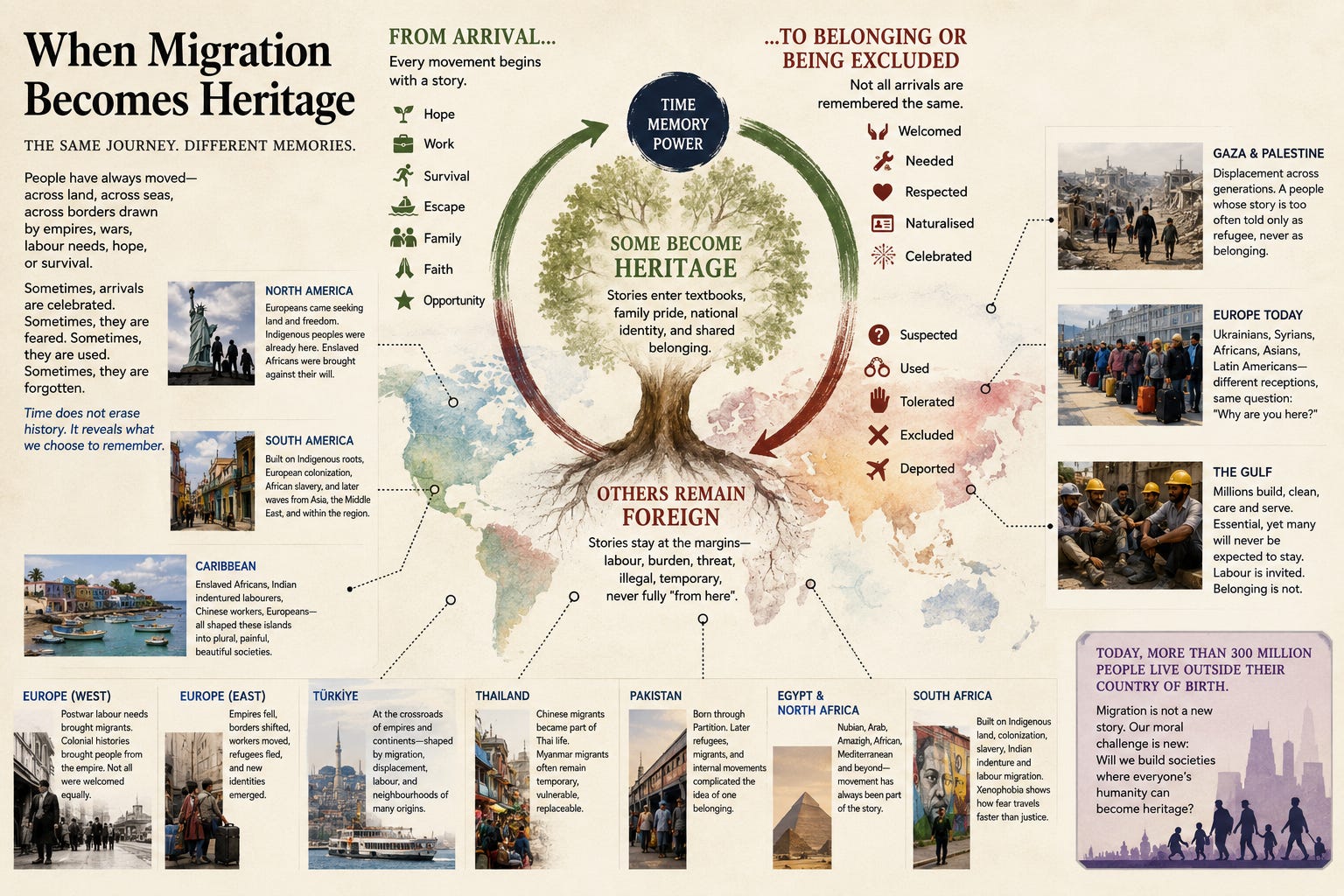
In the last article, I looked at one of the cruelest sentences in political life: “Go back to where you came from.” We saw how false that command can be. For many people, there is no simple “back.” Home may be destroyed, unsafe, occupied, flooded, denied, inherited only as memory, or made impossible by war, hunger, debt, caste, persecution, borders, extraction, climate, or state violence.
But there is another strange thing about migration. Sometimes, when enough time passes, movement stops being called movement. It becomes heritage. It becomes ancestry. It becomes settlement. It becomes nation-building. It becomes “how this country was made.” The same act — people arriving from elsewhere — can be remembered in completely different ways depending on who moved, why they moved, what power came with them, what labour they provided, what violence surrounded them, and what the receiving society later chose to remember.
This is why the easy phrase “we are all migrants” is both true and incomplete. Human beings have always moved, and the world has never been as still as national stories pretend. People have moved across rivers, forests, deserts, oceans, mountains, empires, plantations, borders, farms, factories, universities, wars, famines, marriages, trade routes, labour markets, and family networks. Even today, hundreds of millions of people live outside the country of their birth. But most people in the world still do not migrate internationally. Migration is not the whole human condition, but it is one of the oldest human realities.
Still, we must be careful. A colonizer is not the same as a refugee. A settler is not the same as an enslaved person. A tourist is not the same as a migrant worker. An investor is not the same as an asylum seeker. A retired European in Thailand or Spain is not described in the same way as a domestic worker from the Philippines, Nepal, Sri Lanka, Ethiopia, or Indonesia whose right to stay depends on an employer. A person escaping Gaza, Sudan, Syria, Ukraine, Myanmar, Congo, Afghanistan, or Haiti is not moving in the same way as someone relocating for a job promotion, a business opportunity, or a better climate.
So the better question is not only whether people moved. It is under what conditions they moved. Who made the road? Who owned the ship? Who drew the border? Who needed the labour? Who carried the documents? Who had weapons? Who had no choice? Who was welcomed? Who was used? Who was remembered? Who was allowed, eventually, to become “from here”?
North America is a good place to begin, because Canada and the United States often tell proud stories about immigration. Irish, Scottish, English, French, German, Ukrainian, Italian, Polish, Jewish, Dutch, Scandinavian, Portuguese, Greek, and many other European migrations became woven into national memory. Many of these migrants were poor. Some fled famine, war, religious persecution, antisemitism, class hierarchy, political repression, or lack of land. Many struggled. Many were mocked, excluded, racialized, or treated as undesirable when they first arrived. But over time, many European migration stories became heritage. They became family pride, church histories, prairie settlement stories, neighbourhood names, recipes, surnames, festivals, and local memory.
The country eventually stopped asking many of their descendants to explain why they were there. That is one of the quiet privileges of successful settlement: arrival disappears. The family becomes “from here.” The migration becomes background. The land becomes home. The state becomes natural. The question “Where are you really from?” is directed elsewhere.
But European arrival in North America was not only immigration. It was also settlement on Indigenous land. This is the moral complication that national memory often softens. European settlers did not arrive into empty countries. Indigenous peoples were already here, with languages, laws, nations, trade routes, diplomacy, kinship systems, land relationships, spiritual responsibilities, and forms of governance. The modern states of Canada and the United States did not simply receive newcomers. They were built through treaties, broken treaties, wars, removals, reserves, residential schools, allotment, settlement policy, agriculture, extraction, railways, and legal systems that transformed Indigenous land into national territory.
So the same arrival can carry two memories. For settler descendants, it may be a family story of courage, poverty, sacrifice, winter, farming, faith, hunger, and hard work. For Indigenous peoples, it may be part of a longer story of dispossession, disease, law, removal, child-taking, treaty violation, cultural suppression, and land loss. Both memories may be real, but they do not carry the same moral weight. A family story of hardship does not erase a people’s story of dispossession.
The United States calls itself a nation of immigrants, and that phrase contains truth. But it hides two foundational facts: Indigenous peoples were displaced, and Africans were brought through slavery. Enslaved Africans did not migrate to the Americas in search of opportunity. They were kidnapped, sold, transported, owned, worked, punished, separated, and denied personhood. Their labour helped build wealth, agriculture, trade, cities, universities, banks, ports, and states. Their descendants became central to American culture, politics, music, religion, food, labour, freedom struggles, and democracy itself. But that was not immigration. It was forced movement through violence.
So when any country says it was built by immigrants, we should pause. Who arrived freely? Who arrived with state power? Who was already there? Who was brought in chains? Who was recruited as cheap labour? Who was allowed to become white, settled, respectable, and national? Who remained marked as foreign long after arrival?
South America carries these layered histories too. Brazil is shaped by Indigenous peoples, Portuguese colonization, African slavery, internal migration, Japanese migration, Lebanese and Syrian migration, Italian and German settlement, Haitian and Venezuelan arrivals, Amazonian displacement, and Afro-Brazilian and quilombola struggles for recognition. Argentina, Chile, Uruguay, Colombia, Peru, Venezuela, Suriname, Guyana, and the Caribbean all carry different combinations of Indigenous survival, European settlement, African slavery, Asian labour, Arab migration, internal displacement, and regional movement. Some of these movements became national identity. Others remained at the margins.
Brazilian identity, for example, often celebrates mixture, but mixture does not automatically mean equality. A Japanese Brazilian family may now be recognized as part of Brazil’s plural story. A Lebanese or Syrian family in São Paulo, Mexico City, or Buenos Aires may become part of business, politics, food, and culture. But an Indigenous community defending forest against mining, or an Afro-Brazilian favela resident facing police violence, may also be Brazilian in law while remaining far from the protected centre of the national story. Migration becomes heritage for some; for others, even long belonging remains insecure.
The Caribbean and the Indian Ocean show another route by which movement becomes heritage. After slavery was abolished in many European colonies, plantations still needed labour. Indian indentured workers, and in some places Chinese and other workers, were recruited or coerced through contracts, debt, deception, poverty, famine, and hope, and sent across the empire. Indians went to Mauritius, Guyana, Trinidad, Suriname, Fiji, South Africa, Malaysia, Kenya, and elsewhere. Some returned. Many stayed. Their descendants became Indo-Mauritian, Indo-Guyanese, Indo-Trinidadian, Indo-Surinamese, Indo-Fijian, Indian South African, and more.
What began as colonial labour became family, food, language, prayer, music, politics, and citizenship. Mauritius is not understandable without slavery, French and British colonialism, Indian indenture, African ancestry, Creole culture, Chinese migration, religion, sugar, labour, and the making of a plural society. Suriname is not understandable without Indigenous peoples, Dutch colonialism, slavery, Maroon communities, Indian indenture, Javanese indenture, Chinese migration, and many other layers. Trinidad and Guyana carry similar histories of Indigenous presence, slavery, African survival, Indian indenture, European rule, Chinese and Portuguese migration, and postcolonial politics.
These societies are plural, but not in a shallow postcard sense. Their pluralism did not fall from the sky. It was made through violence, labour, survival, adaptation, marriage, conflict, food, music, language, resistance, and time. A festival may carry joy, but it may also carry the memory of why people had to cross the ocean in the first place. Heritage can be beautiful and painful at once.
Europe, too, often forgets the histories that made its migrations possible. Britain did not simply receive strangers from the Caribbean and South Asia after the Second World War. It received people from places already shaped by British empire, British law, British language, British education, British labour demand, and British citizenship regimes. The Windrush generation helped rebuild postwar Britain and worked in hospitals, transport, factories, public services, and neighbourhood economies. Yet many were later treated as outsiders in the country that had called them.
This is one of the great dishonesties of empire. Empire moves outward for centuries with ships, flags, armies, companies, missionaries, schools, railways, maps, plantations, mines, and laws. Then, when people from colonized places move toward the imperial centre, they are treated as if they arrived without history. A Jamaican in Britain, an Indian or Pakistani in Britain, an Algerian in France, a Congolese person in Belgium, a Surinamese person in the Netherlands, an Angolan or Cape Verdean in Portugal, an Indonesian in the Netherlands — these are not simply stories of foreigners arriving in Europe. They are stories of people moving through imperial roads that already existed.
The colonizer moved first. The colonized followed later. Then the colonizer asked: why are you here?
Germany tells the story differently, but the pattern is familiar. Turkish workers were invited as “guest workers” in the postwar economy. The word “guest” did enormous work. It suggested temporary presence, useful labour, and limited belonging. But people built lives. Children were born. Neighbourhoods changed. Turkish-German life became part of Germany, even when Germany struggled to admit that it had become a country of immigration. Later, Syrians, Afghans, Iraqis, Ukrainians, Africans, and others entered German public life through refuge, asylum, work, study, and family. Germany now contains many histories of arrival, but not all are remembered with the same warmth.
Eastern Europe carries another kind of movement. Poles, Ukrainians, Romanians, Bulgarians, Lithuanians, Bosnians, Serbs, Croats, Albanians, Roma, Jews, Armenians, and many others have moved through war, empire, labour, border changes, EU mobility, ethnic cleansing, economic transition, and political upheaval. Some Eastern Europeans became “hard-working migrants” in Western Europe. Others were treated as cheap labour, suspicious outsiders, or temporary bodies for farms, care work, construction, warehouses, and services. Ukrainian refugees in recent years were received with real sympathy in many places, and rightly so. But that reception also revealed how differently Europe can respond depending on race, religion, geography, and political imagination.
Southern Europe carries similar contradictions. Spain receives Latin Americans through language and history, Moroccans through proximity and labour, Romanians through European mobility, and Africans through dangerous crossings. Italy has its own histories of emigration, colonialism, return migration, Albanian arrivals, African migration, and Mediterranean rescue politics. Greece sits at the edge of Europe’s border regime, shaped by Syrian, Afghan, Iraqi, Pakistani, African, and other movements. These countries know migration both as memory and as current anxiety. Millions of Italians, Greeks, Portuguese, Spaniards, Irish, Poles, and others once left Europe in search of survival. Yet Europe today often acts as if movement toward it is a new violation.
Türkiye sits between these worlds. It carries the afterlife of empire, the making of Turkish national identity, Kurdish belonging and repression, Armenian and Greek memory, Balkan and Caucasus migrations, Syrian displacement, Afghan movement, and labour migration. A Syrian child in Istanbul may grow up speaking Turkish, attending Turkish school, and knowing Turkish streets, while still being told that Syria is the real home. A Kurdish citizen may have a Turkish passport, but the passport does not settle language, memory, recognition, or political belonging. Türkiye is not outside the story of migration becoming heritage; it is one of the places where old movements have become part of the nation while newer ones remain unsettled.
Thailand carries another version. Chinese migration became deeply woven into Thai business, politics, family life, food, and urban culture, often through assimilation over generations. But Myanmar migrants and refugees — Karen, Karenni, Rohingya, Mon, Shan, Chin, Bamar, Rakhine and others — often remain temporary, undocumented, camp-based, tolerated, deportable, or useful but not fully belonging. The Thai economy may need migrant workers in fisheries, construction, agriculture, domestic work, factories, and services. But need does not always become welcome. Labour may be absorbed long before people are.
Pakistan also forces us to think carefully about migration and nation-making. Pakistan itself was born through Partition, one of the largest and most violent migrations of the twentieth century. Millions of Muslims moved toward Pakistan; millions of Hindus and Sikhs moved toward India; many were killed, abducted, uprooted, or permanently separated from land, memory, and neighbours. For some families, migration became the founding story of Pakistan. For others, especially communities already living in Sindh, Balochistan, Punjab, Pashtun regions, and elsewhere, the new state did not erase older regional, linguistic, ethnic, and class tensions. Later Afghan refugees, Bengali histories, Bihari stranded communities, and internal movements complicated the national story further. A state born through migration can still become anxious about migrants.
India carries these tensions too. Partition made refugees into citizens, but not equally and not without trauma. Punjabis, Sindhis, Bengalis, Muslims, Hindus, Sikhs, and many others carry Partition differently. Later, Tibetans in India built exile communities, schools, monasteries, markets, and political life. Nepali-speaking Indians in Darjeeling, Sikkim, Assam, and elsewhere may be Indian citizens and still be misrecognized as foreign. People from Nagaland, Manipur, Mizoram, Meghalaya, Arunachal Pradesh, and other northeastern states may be fully Indian while being treated as outsiders in mainland cities. Bihari and Uttar Pradesh workers in Mumbai may be legally Indian but socially told to go home. Internal migration can expose how a country contains many nations of feeling inside one legal state.
Egypt and North Africa carry other layers. Egypt has long been a centre of Arab, African, Mediterranean, Nubian, Coptic, Sudanese, Palestinian, Syrian, and other histories. Egyptians themselves have migrated across the Gulf, Europe, and North America for work and education. Sudanese, Syrians, Palestinians, Yemenis, Eritreans, Ethiopians, and others have also passed through or settled in Egypt under different kinds of welcome, suspicion, and vulnerability. North Africa more broadly connects Arab, Amazigh, African, Mediterranean, European, and colonial histories. People move north toward Europe, east toward the Gulf, south across the Sahara, and within the region itself. Yet Europe often sees only the boat, not the long history of empire, labour, borders, war, and uneven development behind it.
South Africa shows how migration, race, labour, and belonging can turn violently inward. The country was built through Indigenous dispossession, Dutch and British colonization, slavery, Indian indenture, African labour migration, mining economies, apartheid pass laws, and regional labour systems that drew workers from Lesotho, Mozambique, Zimbabwe, Malawi, and elsewhere. Post-apartheid South Africa became a place of hope for many Africans, but also a place where migrants from Zimbabwe, Mozambique, Nigeria, Somalia, Congo, Ethiopia, Malawi, and elsewhere have faced xenophobic violence. This is one of the painful truths of wounded nations: people who have survived racial exclusion can still exclude others when poverty, inequality, and political failure are redirected toward migrants.
Gaza and Palestine bring the question of heritage and migration into even sharper moral focus. Palestinians are often described through displacement: refugees, occupied people, diaspora, stateless persons, residents, citizens of other states, people under blockade, people in camps, people with keys and deeds to homes they cannot return to. Yet Palestinian belonging is not reducible to displacement. It is also land, memory, food, language, poetry, farming, family, city, village, sea, olive tree, school, grief, and political claim. A Palestinian in Gaza, the West Bank, East Jerusalem, Israel, Lebanon, Jordan, Chile, Germany, Canada, or elsewhere may carry more than one place, but that does not make the belonging vague. It may make it more precise.
This is why the question of migration becoming heritage cannot be separated from power. Some movements are allowed to ripen into national belonging. Others are frozen forever as threat. Some families cross borders and, after two or three generations, become local. Others remain suspicious after five. Some languages become part of national charm. Others become signs of refusal to integrate. Some foods become beloved. Some religious buildings become targets. Some names become ordinary. Others keep triggering questions.
The timeline is not neutral. First, migrants may be visible. Then they may become useful. Then they may be resented. Then some settle. Children grow up. Accents change. Food enters the national kitchen. Names enter politics. Music enters the mainstream. Memory softens. The group once seen as foreign becomes part of “our diversity.” But this does not happen for everyone. Some people remain permanently temporary. Migrant workers in the Gulf, for example, have built cities, homes, hotels, roads, stadiums, and care systems, but many are not expected to become citizens. South Asian, Filipino, African, Arab, and other workers may live for years in Saudi Arabia, the United Arab Emirates, Qatar, Kuwait, Bahrain, or Oman, while belonging remains tied to labour contracts and permission to stay.
This pattern appears in agriculture and care work across North America and Europe too. Seasonal workers plant, harvest, process, clean, pack, cook, care, and build, but are expected to remain temporary even when the work itself is permanent. The economy repeats the invitation. The nation withholds the embrace. A country may want the worker, but not the neighbour. It may want the labour, but not the family. It may want the food harvested, the child cared for, the elder looked after, the hotel cleaned, the house built, but not the political claim that follows from a human life rooted in place.
So we need to ask: how long does someone have to live in a place before they are no longer treated as arriving? One generation? Two? Three? A century? Does it depend on language, religion, skin, class, marriage, property, citizenship, whiteness, usefulness, or whether the national story has found a flattering way to include them?
This is where migration becomes a test of national honesty. A country may celebrate immigrant food while rejecting immigrant people. It may enjoy music, restaurants, festivals, and labour while fearing language, religion, family reunification, political voice, and demographic change. It may praise yesterday’s immigrants for working hard while accusing today’s migrants of failing to integrate. It may forget that yesterday’s immigrants were also once poor, foreign, crowded, mocked, suspected, and blamed.
This does not mean all concerns about migration are false. Large-scale movement can create real pressures around housing, schools, healthcare, language services, employment, wages, infrastructure, social trust, and public planning. People who already feel insecure may experience rapid change as threat. Working-class communities may feel abandoned by governments and then told to celebrate diversity without receiving real support. If public systems are weak, both newcomers and long-settled residents suffer.
But this is precisely why migration must be discussed seriously, not through slogans. The problem is not that people move. The problem is that movement happens through unequal systems, weak planning, racialized fear, labour exploitation, colonial memory, climate stress, and political opportunism. A serious society asks how to house people well, protect wages, fund schools and healthcare, prevent exploitation, build language access, support both newcomers and existing communities, respect Indigenous rights, and avoid using migration to suppress wages or distract from broken public systems. A dishonest society simply asks, “Why are they here?” as if history had not already answered.
This is why the question “Where are you from?” becomes more complicated with every article in this series. At first, it sounds like a question about origin. Then it becomes a question about paperwork. Then it becomes a question about return. Now it becomes a question about memory.
Who is allowed to become heritage? Who remains foreign? Who is remembered as pioneer? Who is remembered as invader? Who is remembered as settler? Who is remembered as slave? Who is remembered as labour? Who is remembered as refugee? Who is remembered as citizen? Who is remembered at all?
The answer is rarely innocent.
Migration unsettles nationality because it shows that countries are not as old, pure, settled, or self-contained as they pretend. It shows that “from here” often began somewhere else. It shows that the people now asking others to explain their arrival may be descendants of people whose own arrival has been softened by time. It does not mean all movement is the same. It means all belonging has a history.
A person may be from a place of birth, a place of ancestry, a place of labour, a place of refuge, a place of settlement, a place of exile, a place of memory, a place of violence, a place of love, and a place that finally stopped asking them to explain themselves.
Migration becomes heritage when a society allows time to soften arrival into belonging. But perhaps justice requires something more difficult: to recognize belonging before generations have to pass, to see the human being before the national story has approved them, to understand that the newcomer of today may be the ancestor of tomorrow, and to remember that every heritage was once an arrival.
End note
This article is written as a civic essay rather than an academic paper, but it is informed by scholarship on nationalism, migration history, diaspora, postcolonial theory, settler colonialism, labour migration, race, citizenship, and memory. Benedict Anderson and Michael Billig help explain how nations become emotionally real through shared stories and everyday habits, while Rogers Brubaker, Nira Yuval-Davis, Seyla Benhabib, Andreas Wimmer, and Nina Glick Schiller help frame the question of who is allowed to belong, and how the nation-state is often treated as the natural container of society.
The article also draws from postcolonial and diaspora thinkers such as Stuart Hall, Avtar Brah, Paul Gilroy, Edward Said, Frantz Fanon, Partha Chatterjee, and Abdelmalek Sayad, whose work helps us understand migration as more than movement across borders. Migration is also shaped by empire, slavery, indenture, labour recruitment, colonial education, language, law, racial hierarchy, family memory, exile, and unequal global power. This is especially important when people from formerly colonized countries are treated as strangers in the very countries whose empires once shaped their economies, borders, institutions, and migration routes.
The discussion of European settlement and Indigenous dispossession is also informed by Indigenous and settler-colonial scholarship, including Patrick Wolfe, Glen Coulthard, Audra Simpson, and Eve Tuck and K. Wayne Yang. Their work helps us remember that in places such as Canada, the United States, Australia, Brazil, and elsewhere, the modern state did not simply receive migrants; it arrived over peoples who were already there. Some movements became founding myths, while Indigenous presence was turned into a file, a category, or a problem to be managed.
The factual background is shaped by migration histories from North America, South America, Europe, Eastern Europe, South Africa, Egypt and North Africa, Türkiye, Thailand, Pakistan, India, the Caribbean, the Gulf, and other regions, as well as by current global migration data from UN and migration agencies. Together, these works and histories help frame the article’s central argument: migration becomes heritage when time, power, law, memory, and national storytelling allow some arrivals to become part of “us,” while other arrivals remain marked as foreign, temporary, threatening, or disposable.