
When the State Decides Who Counts
Part Two: Where Are You From?

This essay series draws from nationalism studies, migration and refugee studies, postcolonial theory, Indigenous studies, citizenship and state power, and memory studies — but tries to speak in public language, because these questions live in passports, borders, classrooms, workplaces, family stories, and everyday conversations. At its heart, the series asks what these fields have long shown in different ways: that the nation is powerful, useful, and emotionally real — but still far too small to contain the full truth of human belonging.
I have learned, across my own life, that the state does not meet us first as whole human beings. It meets us through categories, and those categories decide how the state treats us. I was born in India, later worked in Zambia and Thailand as a work-permit holder and expatriate, held U.S. immigration status first as an intracompany transferee and later as a green-card holder, carried UK residence and work authorization connected to my employer, came to Canada first through a work-permit pathway before becoming a permanent resident and then a citizen, and now remain connected to India through OCI status. I was the same person through all of this, carrying the same memories, work, relationships, commitments, and sense of self. But each state named me differently, permitted me differently, limited me differently, and treated me differently. This article begins there — with the moment when “Where are you from?” stops being only a human question and becomes a state decision about what kind of person we are allowed to be in law.
I hope to publish the concluding part on June 20, World Refugee Day. Wish me luck, and please share your thoughts, comments, disagreements, and reflections. I will truly welcome and appreciate them.
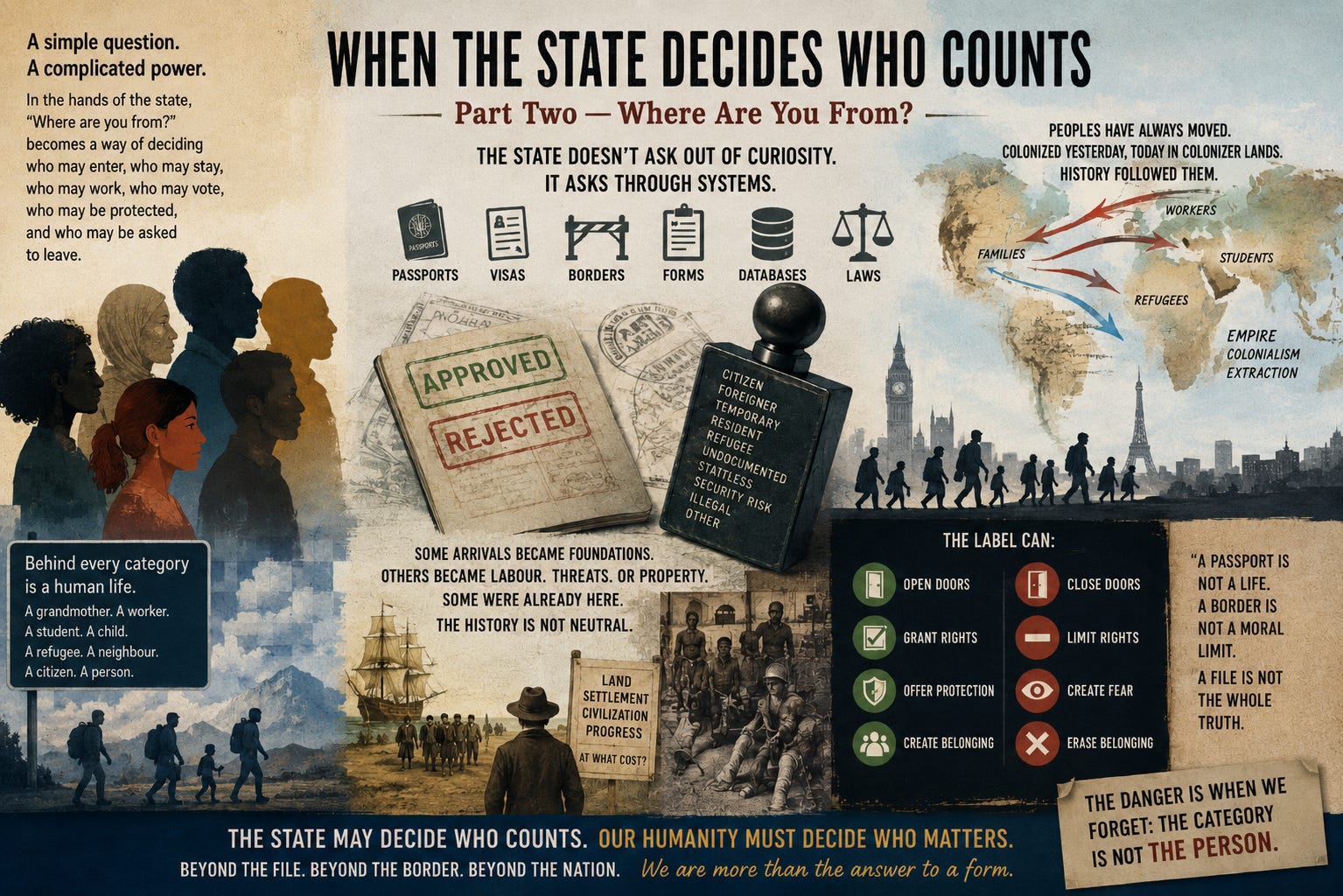
In the first article, we began with a simple question.
Where are you from?
At first, it sounded personal: place, childhood, language, family, food, memory, migration, belonging. But the question did not stay simple.
For some people, the answer is accepted.
For others, it is questioned.
No, where are you really from?
That second question revealed something important: belonging is not only something we feel. It is also something others grant, doubt, test, or withhold.
But there is another level beneath this.
A neighbour may ask where you are from because they are curious.
The state asks because it must decide what to do with you.
That is a very different question.
The state does not ask “Where are you from?” as a conversation starter. It asks through passports, visas, border interviews, citizenship tests, refugee hearings, work permits, police checks, census boxes, school registrations, tax numbers, health cards, detention notices, deportation orders, and identity documents.
It asks in categories.
Citizen.
Foreigner.
Permanent resident.
Temporary resident.
Refugee.
Asylum seeker.
Migrant worker.
International student.
Undocumented person.
Stateless person.
Indigenous person.
Status Indian.
Non-status Indian.
Minority.
National.
Alien.
Security risk.
Illegal.
These words look administrative.
But they organize human life.
They decide who may enter and who must wait. Who may work and who must hide. Who may vote and who must live under laws they did not help make. Who may receive healthcare. Who may cross a border. Who may bring family. Who may be detained. Who may be deported. Who may be counted. Who may be believed. Who may be treated as a person with rights, and who may be treated first as a file.
This is why nationality matters.
It is not only feeling, flag, anthem, sport, pride, or identity.
Nationality is also machinery.
And sometimes the machinery protects.
A passport can save a life. Citizenship can give a person the right to vote, work, study, receive care, access courts, cross borders, return home, and claim public protection. A person without recognized nationality or legal status can become terribly exposed. They may live in a country, work, pay rent, raise children, and build community, yet remain one police stop, one expired document, one employer complaint, or one border change away from fear.
So this is not an argument against citizenship.
Citizenship can be a shield.
But the same shield can also become a wall.
The same state that recognizes some people can make others wait outside recognition. The same document that protects one person can expose another person’s lack of protection. The same border that gives legal meaning to public responsibility can become a line where human desperation is sorted into approved and rejected suffering.
This is the second layer of “Where are you from?”
The first layer asks whether society accepts your answer.
The second asks whether the state accepts your existence in the right category.
A Canadian citizen returning through an airport may be tired and impatient with the luggage line. A refugee claimant arriving at the same airport may be carrying the whole weight of a life broken elsewhere. A migrant worker may enter with permission to work, but not always with the power to leave a bad employer easily. An international student may be welcomed as tuition revenue and future labour, while still being treated as temporary. An undocumented person may avoid hospitals, police, schools, and public life because being visible feels dangerous.
The airport sign may say “All Passports.”
But not all passports carry the same weight.
Some passports open doors. Some invite suspicion. Some allow easy return. Some are difficult to replace. Some are backed by powerful states. Some are issued by states that cannot or will not protect their people. Some people have no passport at all.
The world may speak of equal human dignity, but the border does not treat everyone equally.
This is where the neat answer of nationality begins to show its hidden violence.
The state classifies people more cleanly than human beings actually live.
A person may be born in one country, raised in another, work in a third, send money to a fourth, love someone from a fifth, and raise children who answer the question differently again. A person may be legally temporary but socially permanent. A citizen on paper may still be treated as foreign. A person may belong to a people divided across several states. An Indigenous person may belong to land now governed by a state that arrived later. A person may hold documents from a country they cannot safely return to.
But the form still asks for one answer.
Country of birth.
Country of citizenship.
Nationality.
Place of origin.
Immigration status.
The box is small.
The life is not.
Consider Sri Lanka.
A Tamil from the north or east may carry Sri Lankan nationality. But that does not fully explain language, war, displacement, militarization, loss, suspicion, diaspora, and the long struggle over whether the state belongs equally to all its peoples. Hill Country Tamils carry another layered history: descendants of Indian-origin plantation workers brought under British colonial rule, many of whom were made stateless after independence. They were on the island. They worked its land. Their labour helped build its economy. Yet the postcolonial state could still say, in effect: you are not fully of here.
So where were they from?
India? Ceylon? Sri Lanka? The plantation? A colonial labour system? A country that needed their work but hesitated to recognize their belonging?
The state wanted a category.
History gave a wound.
Uganda in 1972 showed another version of this wound, when Idi Amin ordered the expulsion of Asians. Many were of Indian origin, but some had lived in East Africa for generations. Some were born in Uganda. Some had businesses, neighbours, schools, family graves, and no living relationship with India beyond ancestry. Yet they were suddenly told they did not belong.
A person can be local in every lived sense and foreign by political decision.
Türkiye shows another kind of complexity. A Syrian in Türkiye may be legally temporary but socially present for years. A child may grow up speaking Turkish, attending Turkish schools, knowing Turkish streets and neighbours, yet still be told Syria is where they truly belong. A Kurdish citizen of Türkiye may hold the same passport as a Turkish nationalist, but the passport does not settle questions of language, memory, repression, recognition, or peoplehood. Armenian, Greek, Arab, Alevi, refugee, and borderland histories also sit uneasily inside a single national story.
The state category may be real.
It is not always enough.
Thailand and Myanmar show how usefulness and belonging can separate. Myanmar migrant workers help sustain parts of Thailand’s fisheries, construction, agriculture, domestic work, factories, and services. Karen, Karenni, Rohingya, Bamar, Mon, Shan, Chin, Rakhine, and others live near or across borders shaped by war, labour demand, military rule, poverty, trafficking, and survival. Some refugees have lived in border camps for decades. Children may know Thai geography better than a homeland they cannot safely enter. Yet the state may still see them as temporary, foreign, undocumented, tolerated, deportable, or useful but not fully belonging.
The economy may need them before the nation can imagine them.
The United States and Mexico reveal another problem. The U.S.-Mexico border is often spoken of as a line between two countries. But it cuts across older Indigenous lands, family routes, labour systems, trade, language, and histories that existed before the present border had its current meaning. A Mexican worker in California, Texas, Arizona, or elsewhere may be called foreign in a region where Spanish-speaking, Indigenous, Mexican, and mixed histories long predate many Anglo-American national stories. A child brought to the United States young may grow up American in school, language, culture, friendship, and memory, while the state still says their legal belonging is incomplete.
The category may say undocumented.
The life may say classmate, neighbour, taxpayer, caregiver, farm worker, construction worker, student, parent, church member, friend.
The United States and Canada also force us to look backward at European arrival itself.
European settlers did not arrive in North America as “immigrants” in the way the word is often used today. Some came as colonizers, soldiers, missionaries, traders, farmers, religious minorities, poor labourers, refugees, fortune-seekers, or people escaping hunger and hierarchy in Europe. Their reasons were not all the same. Some were powerful. Some were desperate. Some were agents of empire. Some were ordinary families looking for land and survival.
But their arrival was backed, over time, by states, companies, armies, churches, treaties, laws, and ideas of possession that transformed movement into settlement, and settlement into sovereignty.
This matters because modern national memory often treats European arrival as the beginning of the country, while treating later arrivals as immigration into it.
The English, French, Scottish, Irish, German, Dutch, Ukrainian, Italian, Polish, Jewish, Scandinavian, Portuguese, and other European migrations became part of the national fabric of Canada and the United States. Their languages, churches, farms, towns, surnames, and family histories became heritage. Many were once treated with suspicion, especially Irish, Italians, Jews, Eastern Europeans, Catholics, radicals, and others who did not fit the dominant Anglo-Protestant imagination. But over time, many were absorbed into whiteness, settlement, and national belonging.
The state eventually stopped asking many of their descendants to explain why they were there.
But the state did not treat all movement this way.
Indigenous peoples were not entering a new country. The country arrived over them. Africans brought through slavery did not migrate in search of opportunity. Chinese railway workers, Japanese migrants, South Asian workers, Mexican labourers, Caribbean domestic workers, and others were often useful to the economy long before they were fully welcomed into the national story.
So when the state asks “Where are you from?” the question is already loaded with history.
Some arrivals became founders.
Some arrivals became labour.
Some arrivals became threats.
Some arrivals became property.
Some arrivals became citizens only after struggle.
Some peoples were already there and were made into wards, obstacles, minorities, or populations to be administered.
This is not only a North American story.
It also helps explain why people from colonized countries later ended up in colonizer nations.
Indians, Pakistanis, Bangladeshis, Jamaicans, Nigerians, Kenyans, Ghanaians, Malaysians, Irish, Algerians, Moroccans, Senegalese, Congolese, Surinamese, Indonesians, Vietnamese, and many others did not simply appear in Britain, France, Belgium, the Netherlands, Portugal, Spain, or other European countries as strangers from nowhere. Many arrived through routes empire had already made: language, law, education, military service, shipping, labour recruitment, domestic work, postwar rebuilding, colonial citizenship, refugee pathways, family networks, and economies that had connected colony and metropole long before migration became a political panic.
A person from Jamaica in Britain, Algeria in France, Congo in Belgium, Suriname in the Netherlands, Angola in Portugal, India in Britain, or Indonesia in the Netherlands is not simply an outsider arriving at Europe’s door.
They may be standing inside a history Europe helped create.
The colonizer moved first — with ships, flags, armies, companies, missionaries, maps, schools, borders, plantations, and laws. Later, when people from colonized places moved toward the colonizer’s country, they were often treated as if they had arrived without history.
The state category may say immigrant.
The longer history may say: empire came to us before we came here.
Mexico is also not only a country people leave. It is a country of Indigenous peoples, internal migration, returnees from the United States, Central American migrants moving north, asylum seekers, and communities shaped by remittances. A migrant from Guatemala, Honduras, El Salvador, Haiti, Venezuela, or elsewhere may cross Mexico and become visible to the Mexican state as a transit problem, a humanitarian case, a security concern, or a labour presence.
The state may ask: are you passing through?
The person may be asking: where can I survive?
Brazil carries another layered story: Indigenous peoples whose relationship to land predates the Brazilian state; Afro-Brazilian communities tied to slavery, resistance, and police violence; quilombola communities asking for land and recognition; Japanese, Lebanese, Italian, German, Portuguese, Syrian, Haitian, Venezuelan, and other migration histories; and Amazonian territories where land, forest, mining, cattle, agribusiness, illegal extraction, and Indigenous rights collide.
A person may be counted as Brazilian.
But what does that category hold?
The Indigenous community defending forest against illegal mining? The Afro-Brazilian favela resident facing police violence? The Venezuelan family crossing into Roraima? The Haitian worker seeking stability? The quilombola community asking that land and history be recognized?
The national category is large.
But it can still hide who has power and who pays the cost.
China is often spoken of as one country, one state, one civilization, one people. But China also contains Han majority identity, officially recognized ethnic groups, rural-urban divides, internal migration, borderland regions, Tibetans, Uyghurs, Mongols, Hui, Kazakhs, Koreans, and others whose lives do not all fit neatly into one national story.
The state may classify people by ethnicity, household registration, region, language, political trust, education, and mobility. A rural worker may help build the city’s towers, deliver its food, care for its children, and power its factories, while still not enjoying the same ease of urban belonging as those officially rooted there. A Tibetan, Uyghur, or Mongol may be recognized as part of China’s diversity, while also facing pressure over language, religion, movement, education, surveillance, or political loyalty.
Here “Where are you from?” may not only mean country.
It may mean province, ethnicity, registration, language, region, and how closely a person fits the state’s preferred national story.
The collapse of the Soviet Union created another kind of unsettled belonging. Millions of people woke up in new states without having moved at all. Borders changed around them. Russian-speaking communities in Latvia, Estonia, Ukraine, Kazakhstan, and elsewhere found themselves in newly independent states with their own histories, wounds, languages, and fears. Formerly dominant communities could become minorities. Formerly suppressed nations could become states. Memory itself became a citizenship problem.
Palestinians and Kurds show still another limit of state categories.
A Palestinian may live in Gaza, the West Bank, East Jerusalem, Israel, Lebanon, Jordan, Chile, Germany, Canada, or elsewhere. The legal categories may differ: citizen, refugee, resident, stateless, undocumented, protected, restricted, registered, unregistered. But none fully captures land, displacement, occupation, family memory, refugee camps, village names, or the claim to return and recognition.
A Kurd may have Turkish, Syrian, Iraqi, or Iranian citizenship. Each document may be real. Each state may insist on its own national story. But Kurdish peoplehood stretches across borders that did not ask Kurds how they understood land, language, village, mountain, memory, or belonging.
A passport may tell the border officer what state claims the person.
It may not tell the truth of the people.
India carries these tensions inside one state. It contains more languages, regions, religions, castes, tribes, food worlds, political memories, and forms of belonging than any single national story can comfortably hold. A person from Nagaland, Manipur, Mizoram, Meghalaya, Assam, Sikkim, or Arunachal Pradesh may be fully Indian and still be treated as foreign in Delhi, Mumbai, Bengaluru, or other mainland cities. A Nepali-speaking Indian from Darjeeling or Sikkim may be Indian by citizenship and yet asked where they are really from. An Adivasi community may be counted as part of the nation while its land is treated as forest, mineral block, dam site, security zone, or development opportunity.
The state may count people.
But counting is not the same as recognizing.
South Africa, Rwanda, and Nazi Germany show the more terrifying possibilities of classification. Under apartheid, law tried to push Black South Africans outside the political body of the country in which they lived. In Rwanda, the genocide cannot be reduced to identity cards alone, but identity documents helped harden categories that became deadly. In Nazi Germany, Jews were not first murdered in camps. They were first separated by law: citizenship, marriage, work, education, property, movement, and public presence narrowed step by step.
The road to mass violence often begins with classification.
Not always. Not automatically. But often enough that we should be careful with categories.
Indigenous peoples reveal the deepest limit of nationality. In Canada, Australia, the United States, Mexico, Brazil, and elsewhere, Indigenous peoples were not immigrants into modern states. Their nations, laws, land relationships, languages, and sovereignties existed before those states claimed authority over them. Yet states built systems to define, register, relocate, assimilate, enfranchise, remove, educate, police, and administer them.
The state may say: you are a population within our territory.
The people may say: we were here before your territory had this name.
This is why nationality is never only about outsiders.
It also shapes how states govern those already inside.
It decides who is central and who is peripheral. Who is original and who is tolerated. Who is a founding people and who is a minority. Who is protected as culture and who is feared as politics. Who is developed. Who is relocated. Who is watched. Who is spoken for.
Modern states depend on classification. Without categories, they cannot run schools, hospitals, elections, borders, taxation, courts, labour systems, social services, or refugee programmes. Some classification is necessary.
But necessary is not the same as innocent.
Every category asks a question.
Who benefits from this label?
Who is protected by it?
Who is controlled by it?
Who is made visible?
Who is made vulnerable?
Who is allowed to move?
Who is forced to wait?
Who is counted as belonging?
Who is counted as a problem?
This is where the first article’s question becomes sharper.
“Where are you from?” can sound like curiosity.
But in the hands of the state, it can become the beginning of a file.
A file can protect you.
A file can follow you.
A file can open a door.
A file can close one.
A file can say refugee, and make possible safety.
A file can say inadmissible, and return someone to danger.
A file can say citizen, and give rights.
A file can say foreigner, and limit rights.
A file can say temporary, and keep a life suspended.
A file can say security risk, and make a person disappear into suspicion.
A file can say undocumented, and make ordinary life frightening.
Behind every clean word is a messy life.
Someone is deciding whether a grandmother can join her family. Whether a farm worker can leave an abusive employer. Whether a child can go to school. Whether a refugee’s story is credible. Whether a person can travel to a funeral. Whether a student can stay after graduation. Whether a person belongs enough to be heard.
This does not mean states are always malicious. Some officials act with decency. Some systems save lives. Some citizenship laws repair old exclusions. Some refugee programmes offer genuine refuge. Some courts protect people from state overreach.
But even good systems classify.
And classification changes the person being classified.
A refugee learns to tell their life as evidence. A migrant worker learns which rights are safe to claim. An international student learns which mistakes may threaten their future. An undocumented parent learns which public places feel unsafe. A rural migrant learns that moving to a city does not always mean fully belonging there. An Indigenous person learns that the state may recognize identity in one context and deny authority in another. A minority learns that citizenship may not protect them from suspicion. A dissident learns that nationality can become a cage when the state claims to speak for the people.
This is the deeper danger.
The state does not only decide who comes in.
It decides what kind of person someone is allowed to be once inside.
Grateful refugee.
Useful worker.
Promising student.
Good immigrant.
Assimilated citizen.
Recognized minority.
Peaceful Indigenous community.
Loyal national.
Acceptable critic.
The moment a person steps outside the approved role, suspicion begins.
The refugee who criticizes the host country is told to be grateful.
The immigrant who complains is told they chose to come.
The minority who names discrimination is told not to divide the nation.
The Indigenous person who speaks of land is told not to block development.
The citizen who criticizes the state is told they are anti-national.
So the border is not only at the airport.
It continues inside the country.
It continues in the workplace, the school, the police station, the hospital, the media, the comment section, the political speech, the dinner table, the casual question, the second question.
No, where are you really from?
The state may not ask it in those exact words.
But its systems often do.
Where are you from, legally?
Where are you from, racially?
Where are you from, historically?
Where are you from, in terms of risk?
Where are you from, in terms of loyalty?
Where are you from, in terms of usefulness?
Where are you from, in terms of whether we owe you anything?
This is why nationality can never be only a personal identity.
It is a relationship with power.
It gives some people the right to move easily and others the burden of explaining every movement. It gives some people the comfort of being assumed to belong and others the exhaustion of proving it. It gives some people a state that protects them abroad and others a state they fled from, fear, or cannot rely on. It gives some people the confidence to criticize and others the fear that criticism will put their belonging at risk.
And yet, we still need something like public belonging.
That is the tension.
We cannot simply say the nation-state does not matter. It does matter. It builds hospitals, schools, courts, elections, roads, pensions, labour laws, emergency systems, and public protections. It can receive refugees. It can recognize rights. It can make strangers responsible to one another through law.
But the state must not be allowed to become the whole measure of belonging.
Because human beings are not only citizens or foreigners.
They are also parents, children, workers, neighbours, elders, students, farmers, artists, survivors, believers, doubters, speakers of languages, carriers of memory, members of peoples, inhabitants of land, and lives shaped by histories that no single document can hold.
So when the state asks, “Where are you from?” we should understand what is at stake.
Sometimes the answer brings protection.
Sometimes it brings suspicion.
Sometimes it gives rights.
Sometimes it takes them away.
Sometimes it tells the truth.
Sometimes it hides the larger story.
The danger begins when we forget that the category is not the person.
A passport is not a life.
A visa is not a story.
A border is not a moral limit.
A citizenship line is not the full measure of belonging.
A state file is not the whole truth of where someone is from.
And once we see that, the next question begins.
If states decide who counts, what happens to people whose lives no longer fit the state’s map?
What happens when war, persecution, climate, poverty, occupation, debt, extraction, or fear pushes people out of the place nationality said was theirs?
What happens when “go back to where you came from” has nowhere safe, simple, or honest to point?
That is where we turn next.
End note
This article is written as a civic essay rather than an academic paper, but it draws from several bodies of scholarship that have shaped how we understand nationhood, citizenship, migration, colonialism, and belonging. Benedict Anderson’s idea of nations as “imagined communities” and Michael Billig’s work on “banal nationalism” help explain why national identity feels so natural in everyday life, even though it is constantly produced through ordinary habits, documents, flags, maps, media, schools, sports, and public language. Rogers Brubaker’s work on citizenship and nationhood, Seyla Benhabib’s writing on “the rights of others,” and Andreas Wimmer and Nina Glick Schiller’s critique of “methodological nationalism” help show how the nation-state is often treated as the natural container of society, even when real human lives do not fit neatly inside one national box.
The article is also informed by migration and refugee studies, especially Liisa Malkki’s work on refugees and the “national order of things,” which helps explain why displaced people so often unsettle the assumption that every person naturally belongs to one state, one territory, and one passport. Nira Yuval-Davis’s work on the “politics of belonging” is also important here, because it reminds us that belonging is not only legal or emotional; it is also something societies and states actively grant, deny, test, and police.
The discussion of Indigenous peoples, European settlement, and colonized peoples later arriving in colonizer nations is shaped by postcolonial and Indigenous scholarship, including Frantz Fanon, Edward Said, Partha Chatterjee, Patrick Wolfe, Glen Coulthard, Audra Simpson, and Eve Tuck and K. Wayne Yang. These writers, in different ways, help us see that the modern nation-state did not simply receive people; in many places, it arrived over peoples who were already there. They also help explain why people from colonized countries later appearing in Britain, France, Belgium, the Netherlands, Portugal, Spain, Canada, the United States, and other former imperial or settler states cannot honestly be understood as strangers without history.
Together, these works help frame the central argument of this article: citizenship can protect, but it can also sort, rank, delay, exclude, discipline, and erase. The question “Where are you from?” is therefore never only personal. In the hands of the state, it can become a decision about who counts, who belongs, who must wait, who must prove themselves, and who remains outside the story a nation tells about itself.